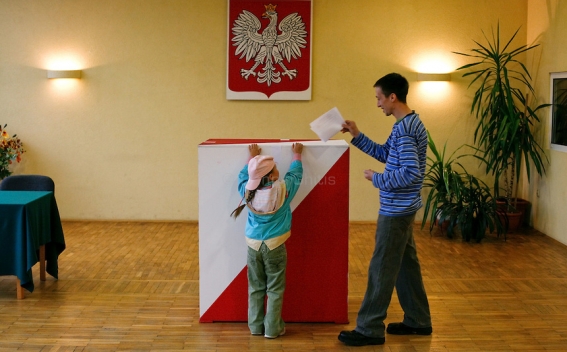
As countries across Europe and the world struggle with the pandemic outbreak of coronavirus, life for many has come to a sudden halt. In these uncertain times Poland finds itself in the run up to the Presidential elections, scheduled to take place on May 10th. Should none of the candidates secure an overall majority, a second and final vote will take place two weeks later.
The Polish government has passed emergency measures to tackle the impacts of the pandemic, restricting public events, all non-essential commerce and international travel in a bid to ensure public safety. However, with just under 50 days until the nation is set to go to the polls, the right-wing-populist PiS government has shown no intention of postponing the elections. It maintains the opinion that there is no legitimate reason to reschedule, which would require a declaration of a state of emergency or an amendment to the constitution. It begs the question — why would the government push ahead with an election the outcome of which is likely to be deemed illegitimate?
With restrictions on public gatherings, opposition candidates have seen their campaigns effectively shut down, as citizens are told to stay home and self-isolate. The presidential hopefuls are unable to use their usual campaign tactics which heavily rely on traveling across the country and meeting with voters along the campaign trail. Meanwhile, Andrzej Duda – PiS candidate and the current President – is using his presidential prerogative to continue to travel and appear across the country, effectively using his office to continue presidential campaign bid.
From a democratic standard point of view, the decision to go ahead with the elections is a cause for concern.
In the first week of March, Duda had signed a controversial legislation passed by Sejm that entitled the state-run TV channels to 2 billion PLN, the equivalent of just under 450,000,000 Euro. The move had been heavily criticised by the opposition who called for the funds to instead be used to support cancer treatments hospitals, accusing PiS of using large sums of tax-payers’ money to fund their own propaganda outlets. But the legislation went ahead anyway. This already raised eyebrows of critics who questioned the fairness of an election, in which the national media is not independent.
Without exposure on national television and unable to conduct meetings with voters, there are no grounds for fair campaigning, opposition argues.
Further, holding the elections in May not only compromises the fairness of campaigning, but also risks compromising citizens’ rights. The government has introduced heavy fines for quarantined individuals for breaking the terms of their quarantine. Would they be punished for going to polling stations? You can hypothetically imagine voters having their temperatures checked before casting their vote? But what would happen to those who appear unwell? Would they be turned away?
This would be a clear violation of their citizens’ rights, notes Wojtek Szacki, journalist for Polityka Insight. Besides, as health concerns intensify, particularly for the most vulnerable, turnout is likely to be hit hard, falling below 50% (2015 presidential election enjoyed turnout of 55.34%), seriously compromising the legitimacy of the outcome.
On top of compromising legitimacy and citizens’ rights, holding the elections amid a pandemic outbreak puts voters, candidates and electoral commission workers’ health at risk.
Ensuring the safety of roughly 300,000 electoral commission workers’ will be near impossible. The work cannot be done remotely, they will be in close contact with one another in each polling station, and exposed to many more thousands of incoming voters. Duda’s reluctance to reschedule the election fundamentally puts workers and voters at risk, exposing his disinterest in the safety of people engaged in the democratic process.
The question we should ask is, why does PiS want to press ahead with an election that is likely to deliver an illegitimate outcome and put citizens’ safety at risk?
‘Forcing’ through an election, despite the extraordinary circumstances demonstrates two things about the position of PiS at this time — nervousness and blatant disregard for the democratic process.
Since coming to power in 2015, PiS has maintained its support by a campaign of generous government handouts, most notably 500+ giving 500PLN (110 EUR) a month for each child to every family that claims it, regardless of income. This policy is hugely expensive, accounting for 1.3% of GDP, compared with 4.7% of GDB that makes up public health expenditure. It was always a matter of time before the opportunity cost of this policy would make itself known, and the coronavirus outbreak is brutally exposing the scale of the campaign of negligence of the public health service PiS had conducted since coming to power.
By refusing to move the date of the election PiS is indicating its nervousness. It implies they have reasons to think they will struggle to win the elections should they take place post-pandemic-peak, when the President and government will be judged on how well they dealt with the crisis. There is also Duda’s personal nervousness. He knows he is replaceable and there are others in the PiS camp who are all too ready to replace him for the candiency should there be a new campaign.
Secondly, and perhaps more worryingly, it signals how far gone is PiS’s disregard for the democratic process. If the elections take place, their outcome is unlikely to be seen as legitimate. A recent poll published by “Super Express”, claims that 70% of those asked believe the elections should be postponed, with only 12% of those asked thought the election should go ahead as scheduled. Andrzej Duda is likely to face heavy criticism from the independent media, the opposition and the citizens who wanted to vote, but couldn’t because doing so would be too big a risk to their health. None of this seems to phase the current President who insists on pressing on with the election in May.
In a series of PiS policies resulting in the weakening of the democratic practice in Poland, this feels like a final straw. First the media, then the judiciary and now the undermining of electoral integrity. Although a sign of weakness of confidence in the PiS camp, it is also a script for authoritarianism, history knows all too well.
As liberal Europeans we must stay vigilant and remember that democratic values and practices are delicate and require constant guardianship. All power corrupts, even in the hands of the most well meaning of leaders. It is the responsibility of us all to ensure such power has no opportunity to become absolute.
http://4liberty.eu/fmay-presidential-election-in-poland-as-planned/ to go to 4liberty.eu where this article was originally published
 Maria Slominska Fabis
Leave a comment